EryonStudio, healthcare motion design studio
Our films, the method, the communication kit and the process, from idea to final version.
The video shows the steps and warnings of your medical devices' instructions for use, in 2D or 3D, for each user profile. If you share it, your use-related risk analysis points to the steps to animate first.

Each scene covers one step, in the words of the IFU.
Each step of the IFU becomes a chapter of the video: users go straight back to the step they need to redo.
Every check and every warning in the IFU appears at the moment of the step it concerns.
Patient at home or biomedical technician: vocabulary and environment change, and the film follows your use specification.
Numbered versions and a referenced script: the video goes into your formative and summative evaluations, run by your teams or your provider.
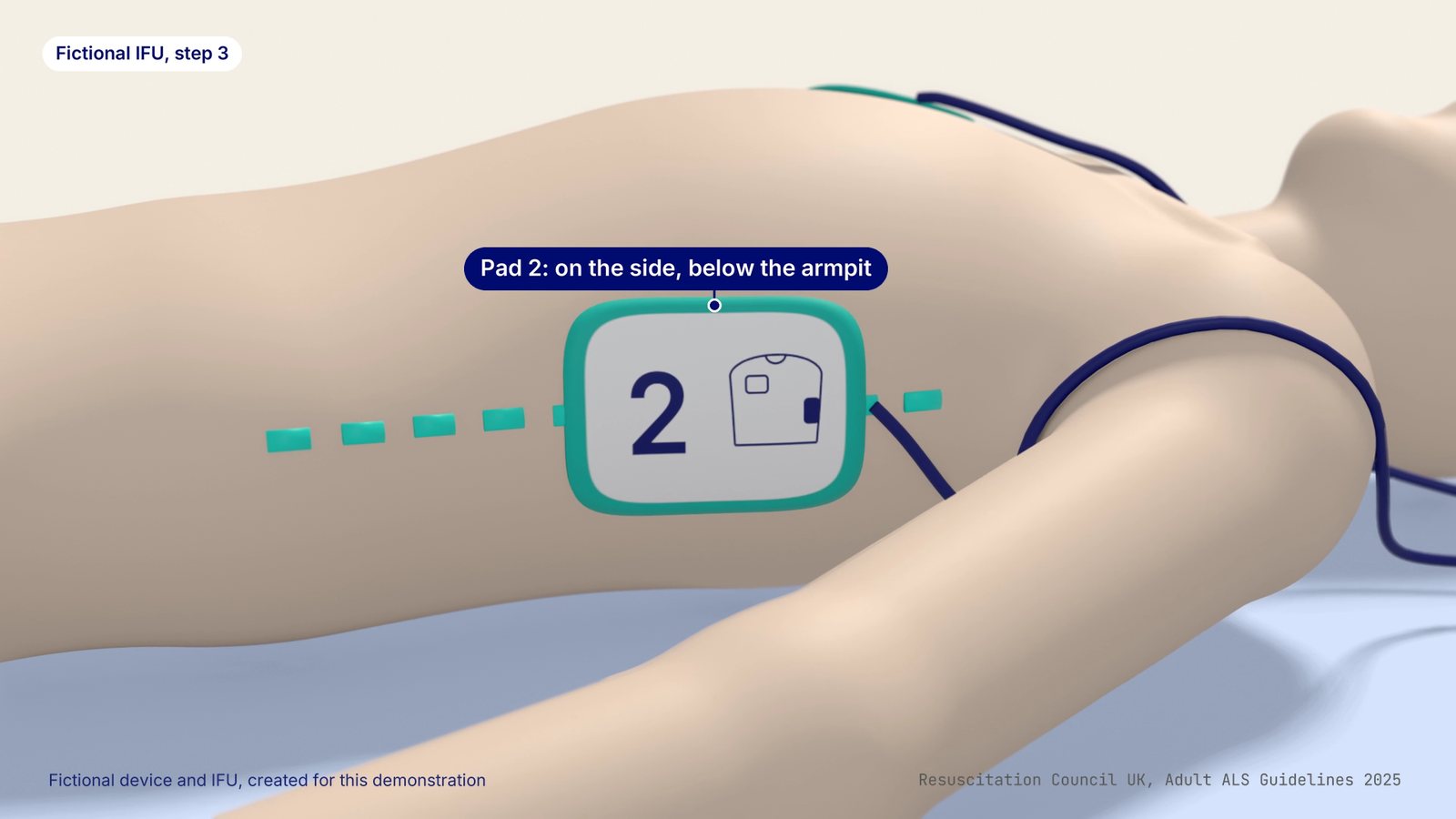
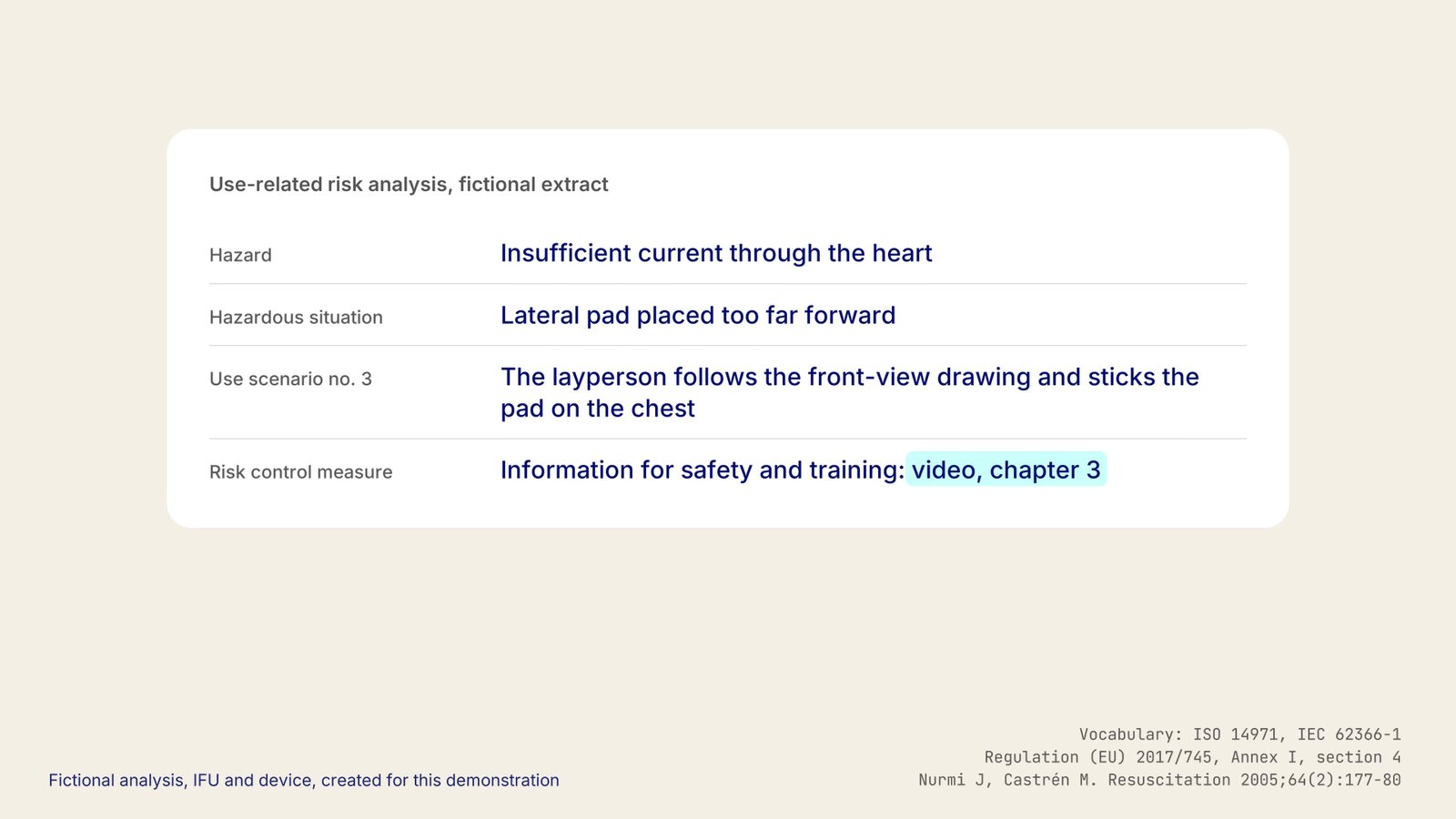
The demo shows pad placement on a fictional defibrillator. On a front-view diagram, as in an IFU, the lateral pad easily ends up too far forward; the side view shows where it goes, below the armpit. With the pad pictograms of five manufacturers, laypeople most often placed it too far forward: a documented use error, which the authors suggest preventing with a side view (Nurmi and Castrén, 2005).
A step is learnt at launch, then learnt again after feedback from the field.
Before your evaluations: when training is part of what you evaluate, the video is ready and frozen before the summative evaluation.
At launch: training the first patients and the first healthcare professionals, in hospital and at home.
After feedback from the field: a complaint concerns a step, and the video reworks that step, alongside the measures you decide.
When the IFU changes: only the scenes of the modified steps are redone.
For a new market: the video in the country's language, based on that country's IFU.
Our sources are yours: instructions for use, use specification and, if you share it, use-related risk analysis with its use scenarios, under a confidentiality agreement. The justification file gives the page and exact passage for every sentence and, when the analysis is shared, links each scene to its line; your teams approve each version.
Objective, audience, where the video will be shown, available references and regulatory points to watch.
Every line is tied to a reference, with its page and the exact passage that supports it.
Motion design and medical animation, with AI assisting part of the production. Diagrams remain illustrations.
An automated check finds every passage, word for word, on the page cited; two independent AI-assisted audits then re-check a sample in the documents; your review committee, or your MLR review in a pharmaceutical company, approves the final version.
Every deliverable states the IFU version it is based on.
Landscape for your website, YouTube and the training room; portrait, square or 4:5 for social media.
SRT file and full text: accessibility, viewing without sound and search visibility for the page that hosts the film.
Every line, its reference, its page and the exact passage, ready for your internal review.
The full list, in order of appearance, with links to the public sources.
Short excerpts, stills, a poster or slides, depending on your channels. Quoted with the final version.
The languages you choose: every translated line keeps its source and exact passage, and the rules of the country where the video is shown are checked at scoping.
Regulation (EU) 2017/745 sets an order of priority: eliminate or reduce risks through design, then take protection measures, and finally provide information for safety and, where appropriate, training to users (Annex I, section 4). Against use errors, the manufacturer takes into account the technical knowledge, experience, education and training of users (Annex I, section 5). A video therefore helps users follow the IFU; it does not correct a design flaw. Kept as a risk control measure in your risk management (ISO 14971), its effectiveness is verified with users, in your usability engineering process (IEC 62366-1). Faithful to the IFU and free of claims, a correct-use video falls outside advertising under the rules of the French agency, the ANSM.